Smallest Hello World Application
A simple exercise — how to develop the smallest possible Hello World application.
Basic Rust code:
cargo new r-helloCode:
fn main() {
    println!("Hello, world!");
}
When built in Release mode, the executable is 125 440 bytes.
We can rewrite this in assembly with minimal optimization and place the data in the .rdata section:
hello PROGRAM Format=PE, Entry=Start, IconFile=

[.rdata]
Msg D "Hallo, Welt!",10,13,0

INCLUDE winapi.htm

[.text]
Start:   nop
    WinAPI GetStdHandle, 0FFFFFFF5h
    WinAPI WriteConsoleA, eax, Msg, 0Fh
    WinAPI ExitProcess 0
ENDPROGRAM
This produces a 1 564‑byte executable (in theory it could be 1 536 bytes with some PE header tricks).
Now we can achieve the same in Rust without std:
#![no_std]
#![no_main]

use core::panic::PanicInfo;

// WinAPI declarations must be inside an unsafe extern block
unsafe extern "system" {
    fn GetStdHandle(nStdHandle: i32) -> isize;
    fn WriteConsoleA(
        hConsoleOutput: isize,
        lpBuffer: *const u8,
        nNumberOfCharsToWrite: u32,
        lpNumberOfCharsWritten: *mut u32,
        lpReserved: *mut core::ffi::c_void,
    ) -> i32;
    fn ExitProcess(uExitCode: u32) -> !;
}

const STD_OUTPUT_HANDLE: i32 = -11;

// Message
static MSG: &[u8] = b"Hallo, Welt!\r\n";

#[unsafe (no_mangle)]
pub extern "C" fn mainCRTStartup() -> ! {
    unsafe {
        let handle = GetStdHandle(STD_OUTPUT_HANDLE);

        WriteConsoleA(
            handle,
            MSG.as_ptr(),
            MSG.len() as u32,
            core::ptr::null_mut(),
            core::ptr::null_mut(),
        );

        ExitProcess(0);
    }
}

#[panic_handler]
fn panic_handler(_info: &PanicInfo) -> ! {
    loop {}
}
Cargo.toml:
[package]
name = "r-hello-nostd"
version = "0.1.0"
edition = "2024"

[dependencies]

[profile.release]
panic = "abort"
lto = true
codegen-units = 1
opt-level = "z"
strip = true
.cargo\config.toml:
[target.x86_64-pc-windows-msvc]
rustflags = [
    "-C", "link-arg=/ENTRY:mainCRTStartup",
    "-C", "link-arg=/SUBSYSTEM:CONSOLE",
    "-C", "panic=abort",
]
and build.rs:
fn main() {
    println!("cargo:rustc-link-lib=kernel32");
}
Result: only 3 072 bytes.
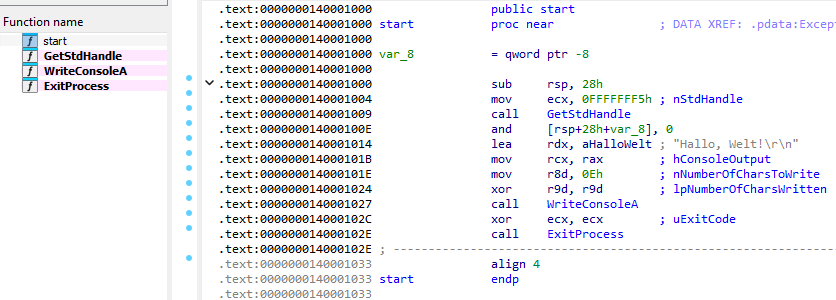
Disassembled:
Enjoy!