Getting CPU String and Passing It to LabVIEW
A simple exercise — how to obtain the CPU brand string using CPUID in Rust and pass it to LabVIEW.
Basic Rust singeliner code:
use raw_cpuid::CpuId;
fn main() {
    dbg!(CpuId::new().get_processor_brand_string());
}
Output:
ProcessorBrandString { as_str: “Intel(R) Core(TM) i7-4800MQ CPU @ 2.70GHz” }
or a little bit more elegant with ® and ™ signs:
use raw_cpuid::CpuId;

fn main() {
    let cpuid = CpuId::new();

    if let Some(vf) = cpuid.get_processor_brand_string() {
        let s = vf.as_str()
            .replace("(R)", "®")
            .replace("(TM)", "™");
        println!("CPU: {}", s);
    }
}
Output:
CPU: Intel® Core™ i7-4800MQ CPU @ 2.70GHz
cargo.toml same for both:
[package]
name = "hello_cpu"
version = "0.1.0"
edition = "2024"

[dependencies]
raw-cpuid = "11.6.0"
Passing the CPU string to LabVIEW #
There are two ways to pass the string:
- As a C string pointer
Requires preallocating the buffer in LabVIEW. Works, but not elegant. - As a LabVIEW string handle (
LStrHandle)
The Rust function resizes the handle internally using LabVIEW’s memory manager. This is the preferred method.
C function prototypes #
/* Call Library source file */

#include "extcode.h"

void funcName_c_ptr(char cpu_string_pointer[], int32_t length)
{
	/* Insert code here */
}

void funcName_str_handle(LStrHandle cpu_string_handle)
{
	/* Insert code here */
}
First we need cargo.toml:
[package]
name = "hello_cpu_lib"
version = "0.1.0"
edition = "2024"

# Cargo.toml

[lib]
crate-type = ["cdylib"]

[dependencies]
raw-cpuid = "11.6.0"
Then src\lib.rs:
// src/lib.rs
use raw_cpuid::CpuId;
use std::ffi::c_void;
use std::os::raw::{c_char, c_int};
use std::ptr::copy_nonoverlapping;
//
// LabVIEW LStr definition (from extcode.h)
//
#[repr(C)]
pub struct LStr {
    pub cnt: i32,     // number of bytes
    pub str: [u8; 1], // flexible array member
}

pub type LStrPtr = *mut LStr;
pub type LStrHandle = *mut LStrPtr;

//
// LabVIEW Memory Manager
//
#[link(name = "labview")]
unsafe extern "C" {
    fn DSSetHandleSize(handle: *mut c_void, new_size: usize) -> i32;
}

//
// Helper: get CPU brand string
//
fn get_cpu_brand_string() -> String {
    let cpuid = CpuId::new();
    cpuid
        .get_processor_brand_string()
        .map(|b| b.as_str().trim_end_matches('\0').to_string())
        .unwrap_or_else(|| "Unknown CPU".to_string())
}

//
// 1) Fill preallocated C string buffer
//
#[unsafe(no_mangle)]
pub extern "C" fn cpu_string_c(buffer: *mut c_char, length: c_int) {
    if buffer.is_null() || length <= 0 {
        return;
    }

    let s = get_cpu_brand_string();
    let bytes = s.as_bytes();

    let max = (length - 1) as usize; // leave room for null terminator
    let n = bytes.len().min(max);

    unsafe {
        copy_nonoverlapping(bytes.as_ptr(), buffer as *mut u8, n);
        *buffer.add(n) = 0; // null terminate
    }
}

//
// 2) Fill LabVIEW LStrHandle (auto-resize)
//
#[unsafe(no_mangle)]
pub extern "C" fn cpu_string_lv(h: LStrHandle) -> i32 {
    if h.is_null() {
        return 1; // mgArgErr
    }

    let s = get_cpu_brand_string();
    let bytes = s.as_bytes();
    let size = bytes.len() as usize;

    unsafe {
        // Resize handle: size = length + sizeof(int32)
        let err = DSSetHandleSize(h as *mut c_void, size + 4);
        if err != 0 {
            return err;
        }

        let ptr = *h;
        if ptr.is_null() {
            return 1;
        }

        (*ptr).cnt = size as i32;

        let dst = (*ptr).str.as_mut_ptr();
        copy_nonoverlapping(bytes.as_ptr(), dst, size);
    }

    0 // mgNoErr
}
And called from LabVIEW:
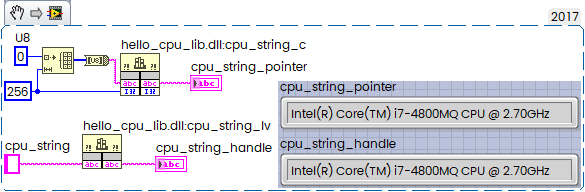
So simple. And that’s it — clean, simple, and fully LabVIEW‑compatible.
Two remarks.
One is about linking. The Rust code is needs to be linked with labview.lib located by default in “C:\Program Files\National Instruments\LabVIEW 2026\cintools” folder. The LabVIEW version could be different, like 2025 or 2024.
This can be automated in build.rs file:
use std::fs;
use std::path::PathBuf;

fn main() {
    let base = PathBuf::from(r"C:\Program Files\National Instruments");

    // Collect all LabVIEW versions that contain cintools/labview.lib
    let mut candidates: Vec<(u32, PathBuf)> = Vec::new();

    if let Ok(entries) = fs::read_dir(&base) {
        for entry in entries.flatten() {
            let path = entry.path();
            if !path.is_dir() {
                continue;
            }

            let name = match path.file_name().and_then(|n| n.to_str()) {
                Some(n) => n,
                None => continue,
            };

            // Folder must start with "LabVIEW "
            if let Some(rest) = name.strip_prefix("LabVIEW ") {
                // Parse version (e.g., 2026, 2025, 2024)
                if let Ok(version) = rest.parse::<u32>() {
                    let cintools = path.join("cintools").join("labview.lib");
                    if cintools.exists() {
                        candidates.push((version, cintools));
                    }
                }
            }
        }
    }

    // Sort by version descending (newest first)
    candidates.sort_by(|a, b| b.0.cmp(&a.0));

    // Pick the newest version
    let Some((version, lib_path)) = candidates.into_iter().next() else {
        panic!("Could not find any LabVIEW installation with cintools/labview.lib");
    };

    let lib_dir = lib_path.parent().unwrap();

    println!(
        "cargo:warning=Using LabVIEW version {} at {:?}",
        version, lib_dir
    );
    println!("cargo:rustc-link-search=native={}", lib_dir.display());
    println!("cargo:rustc-link-lib=static=labview");
    println!("cargo:rustc-link-lib=dylib=user32");
}
Another point is “pretty output” with both ® and ™ signs. Here important point is that the LabVIEW is not supporting Unicode, therefore
//
// Helper: get CPU brand string
//
use encoding_rs::WINDOWS_1252;

fn get_cpu_brand_bytes() -> Vec<u8> {
    let cpuid = CpuId::new();
    let s = cpuid
        .get_processor_brand_string()
        .map(|b| b.as_str().trim_end_matches('\0').to_string())
        .unwrap_or_else(|| "Unknown CPU".to_string());

    // Replace ASCII markers with Unicode symbols
    let unicode = s
        .replace("(R)", "®")
        .replace("(TM)", "™");

    // Encode to Windows‑1252 (ANSI)
    let (encoded, _, _) = WINDOWS_1252.encode(&unicode);

    encoded.into_owned() // <-- raw ANSI bytes
}

//
// 1) Fill preallocated C string buffer
//
#[unsafe(no_mangle)]
pub extern "C" fn cpu_string_c(buffer: *mut c_char, length: c_int) {
    if buffer.is_null() || length <= 0 {
        return;
    }

    let bytes = get_cpu_brand_bytes();

    let max = (length - 1) as usize; // leave room for null terminator
    let n = bytes.len().min(max);

    unsafe {
    /*
    Here:
        buffer: *mut c_char
        But copy_nonoverlapping expects a *mut u8 for byte copying.
        So we cast it: buffer as *mut u8.
        This is necessary because c_char is not guaranteed to be u8 on all platforms
        (it can be signed or unsigned).
        Rust forces you to be explicit.
    */
        copy_nonoverlapping(bytes.as_ptr(), buffer as *mut u8, n);
        *buffer.add(n) = 0; // null terminate
    }
}

//
// 2) Fill LabVIEW LStrHandle (auto-resize)
//
#[unsafe(no_mangle)]
pub extern "C" fn cpu_string_lv(h: LStrHandle) -> i32 {
    if h.is_null() {
        return 1; // mgArgErr
    }

    let bytes = get_cpu_brand_bytes();
    let size = bytes.len();

    unsafe {
        // Resize handle: size = length + sizeof(int32)
        let err = DSSetHandleSize(h as *mut c_void, size + 4);
        if err != 0 {
            return err;
        }

        let ptr = *h;
        if ptr.is_null() {
            return 1;
        }

        (*ptr).cnt = size as i32;

        /*
        str.as_mut_ptr() is already a *mut u8

        pub struct LStr {
            pub cnt: i32,     // number of bytes
            pub str: [u8; 1], // flexible array member
        }

        No cast in copy_nonoverlapping needed:
        */

        let dst = (*ptr).str.as_mut_ptr();
        copy_nonoverlapping(bytes.as_ptr(), dst, size);
    }
    0 // mgNoErr
}
and now
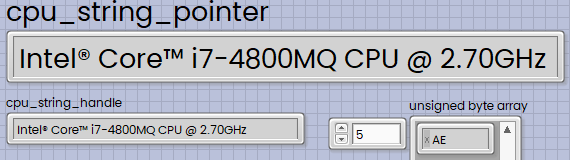
Code.