How to get assembly output from Rust Code
From time to time, it’s useful to inspect the assembly output generated from Rust code. A common problem is locating a specific piece of Rust code inside the assembly listing. Below is a simple trick to make this much easier.
Let’s say we have a trivial example that fills a vector with random values and prints their sum:
use rand::RngExt;

fn main() {
    let mut rng = rand::rng();

    let values: Vec<f64> = (0..1024)
        .map(|_| rng.random::<f64>())
        .collect();

    let sum: f64 = values.iter().sum();
    println!("sum = {}", sum);
}
cargo.toml:
[dependencies]
rand = "0.10.1"
How to get the code behind of let sum: f64 = values.iter().sum(); statement?
The easiest way to find the relevant section in the assembly output is to insert markers using Rust’s inline asm! macro:
//...

    unsafe {
        asm!(
            "// === Prolog ===",
            "nop",
            "// === values.iter().sum():  ===",
        );
    }

    let sum: f64 = values.iter().sum();

    unsafe {
        asm!(
            "// === Epilog ===",
        );
    }
//...
To avoid repeating boilerplate, we can wrap the marker logic in a small macro:
use rand::RngExt;
use std::arch::asm;

macro_rules! mark {
    ($name:expr) => {
        unsafe {
            asm!(concat!("// === ", $name, " ==="));
        }
    };
}

fn main() {
    let mut rng = rand::rng();

    let values: Vec<f64> = (0..1024)
        .map(|_| rng.random::<f64>())
        .collect();

	mark!("Prolog - before values.iter().sum()");
    let sum: f64 = values.iter().sum();
	mark!("Epilog - after values.iter().sum()");

    println!("sum = {}", sum);
}
Now it must be compiled with following command, the output assembly will be in target:
cargo rustc --release -- --emit asm -C opt-level=3 -C "llvm-args=-x86-asm-syntax=intel"
copy target\release\deps\r_asm_marker.s r_asm_marker.s
(I prefer Intel syntax)
Now you can easily find according assembly code in the generated listing:
	#APP

	# === Prolog - before values.iter().sum() ===

	#NO_APP
	movsd	xmm0, qword ptr [rip + __real@8000000000000000]
	mov	ecx, 7
	.p2align	4
.LBB0_18:
	addsd	xmm0, qword ptr [rax + 8*rcx - 56]
	addsd	xmm0, qword ptr [rax + 8*rcx - 48]
	addsd	xmm0, qword ptr [rax + 8*rcx - 40]
	addsd	xmm0, qword ptr [rax + 8*rcx - 32]
	addsd	xmm0, qword ptr [rax + 8*rcx - 24]
	addsd	xmm0, qword ptr [rax + 8*rcx - 16]
	addsd	xmm0, qword ptr [rax + 8*rcx - 8]
	addsd	xmm0, qword ptr [rax + 8*rcx]
	add	rcx, 8
	cmp	rcx, 1031
	jne	.LBB0_18
	movsd	qword ptr [rbp + 56], xmm0
	#APP

	# === Epilog - after values.iter().sum() ===

	#NO_APP
In IDA this code looks like this:
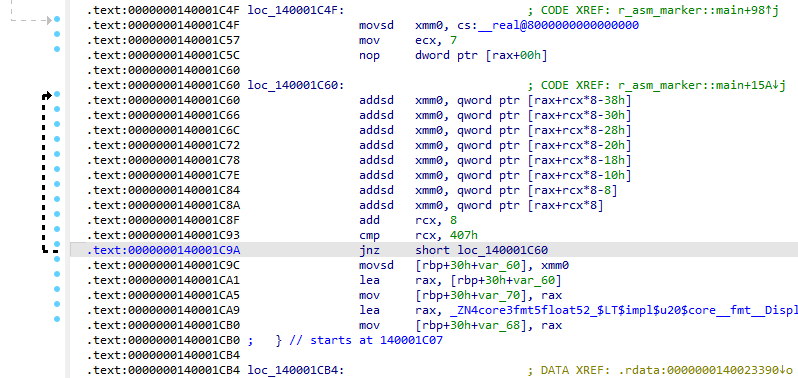
As you can see, Rust does a solid job here: the loop is unrolled, and SIMD instructions are used. (Interesting detail: the loop walks the array backwards.)
Debugging #
If you need to stop at certain point, most easiest way just to put
    unsafe {
        asm!(
            "int 3",
        );
    }
Then, once stopped, step over this instruction in the debugger.
Links #
Inline assembly - The Rust Reference.